Blog / Coughlin Ford of Heath Service

6 Signs Your Ford Needs a Transmission Repair

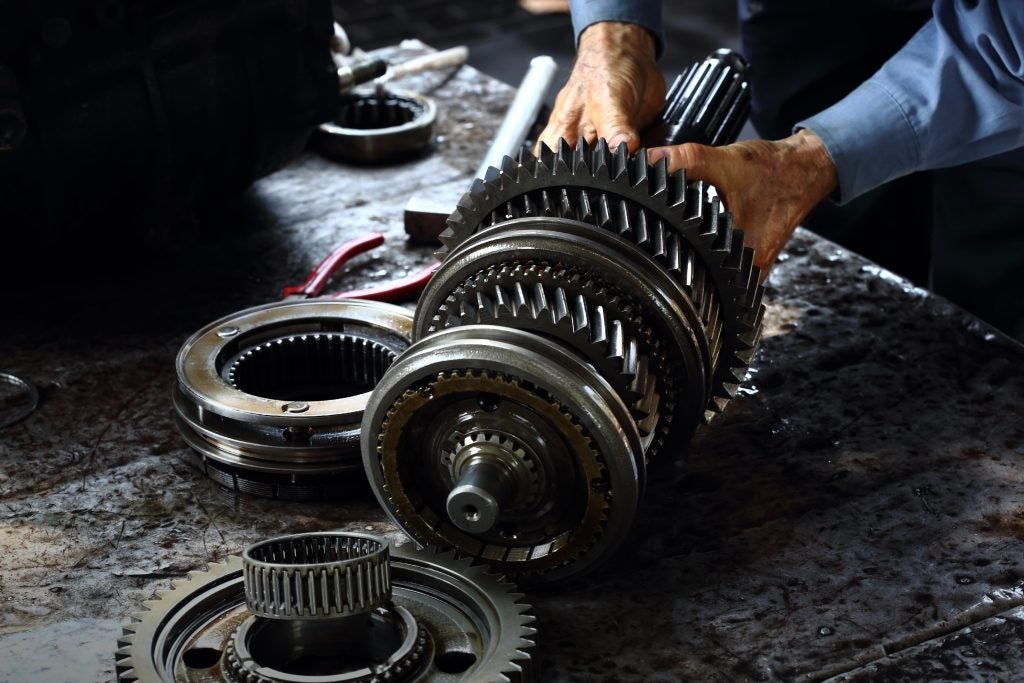
Vehicle transmission.

Automatic transmissions in modern Ford vehicles are remarkably sophisticated. This means they're also expensive to replace – sometimes almost as costly as replacing the engine – so it's crucial to catch possible gearbox problems early and fix them before they grow into something worse. With this in mind, the following six signs of trouble should prompt you to visit your local Ford dealer without delay for transmission repair.

Leaking Transmission Fluid

The intricate mechanical components inside your gearbox are kept in fully functioning form in large part by the transmission fluid. The fluid lubricates, reduces heat, combats corrosion, and cleans out metal debris. On the rare occasion when a Ford car's transmission develops a problem, some sort of fluid issue is usually to blame.

If your transmission ever springs a leak, the transmission can rapidly break down. So it's important to notice and repair leaks quickly. Watch out for any red or brown sweet-smelling fluid pooling under your car. If you ever suspect leaking transmission fluid, don't drive any farther than to reach your nearest technician.

Aging Transmission Fluid

When transmission fluid gets too old, it breaks down, thickens, and burns, losing its function. As a result, your transmission will begin to overheat, potentially leading to a cascade of costly problems.

Aging transmission fluid starts to burn in the growing heat of the gearbox. In this case, you're likely to detect a burning smell. You'll also quickly experience the other warning signs listed below.

Sounds of Grinding Gears

A struggling gearbox will begin to emit awkward grinding sounds while shifting. This is very noticeable as a Ford car's transmission is usually smooth and silent.

Delayed Gear Shifting

When gears wear down or valves stick to valve shafts, you might notice a strange delay of several seconds after shifting before the new gear properly engages. In more severe cases, the gears might refuse to change altogether.

Unexpected Gear Slippage

The most worrisome sign of gearbox issues is when gears begin to slip all on their own. This might be caused by a faulty torque converter or rounded-out gears losing their grip. Needless to say, you'll need to have slipping gears repaired right away.

Engine Revving While Shifting

When gears fail to shift properly, the engine sometimes responds by boosting RPMs. This sudden revving while shifting gears is another surefire indication that your gearbox needs professional attention.

Change Transmission Fluid at Your Local Ford Dealer 

You can prevent most gearbox problems by flushing fluid frequently. Transmission fluid should usually be flushed every 60,000 miles or so.

Consider doing this more often if you drive under more challenging road conditions than the average driver. Manual transmissions also need more frequent flushing: every 30,000 miles or so.

Visit Coughlin Ford of Heath today to have your transmission fluid flushed, or your gearbox inspected and repaired. We're a trusted local dealership providing personalized customer service and top-of-the-range used and new Ford vehicles.

Posted in:

Related Posts

Mechanic,Hand,Checking,And,Fixing,A,Broken,Car,In,Garage.hand

Maintaining Your Ford Fuel System: Service Tips

Your car's engine requires a steady supply of fuel to function properly. Without regular Ford fuel system maintenance, you'll soon experience misfires and stalling. Follow these steps to keep your fuel system healthy and your engine fault-free. Clean the Fuel Injectors The fuel injectors spray gas into each cylinder in a precisely controlled mist. Carbon deposits, dirt, rust, and other debris can gradually clog these injectors, which eventually restricts fuel delivery. It's therefore important to have your fuel injectors routinely cleaned. more Replace the Fuel Filter The fuel filter stops contaminants from entering the fuel and engine. As with every filter in your car, the fuel filter will slowly fill up and eventually let debris through into the fuel. You'll need to replace your fuel filter routinely to prevent this. Only Use Top-Tier Gas The buildup of carbon deposits in a fuel system and engine is comparable to arterial plaque in humans, and just as dangerous. You can combat carbon deposits and reduce the risk of blockages with high-quality fuel that contains effective detergents. Try to use only the very best fuel for your car. Avoid Emptying the Gas Tank It's advisable to keep your gas tank more than a quarter full. If you allow it to empty out, the fuel pump needs to work harder, which accelerates wear and tear. Also, sediment tends to collect at the bottom of a gas tank. When the gas is almost finished, this sediment gets stirred up and drawn into the system, where it causes harm. Clean the Fuel Throttle The fuel throttle regulates how much air enters each cylinder to mix with the fuel. While this throttle is not strictly part of the fuel system, it impacts the fuel injector as the volume of sprayed fuel adjusts to match issues with the fuel throttle and air intake. Therefore, while servicing the fuel system, a technician will often check the fuel throttle and clean away fuel varnish or other debris to keep it unblocked. Book Ford Fuel System Maintenance All these components of your fuel system will typically need to be checked and cleaned every 30,000 miles. Consult your owner's manual for specific guidance on your Ford model. In addition, many drivers have their engines tuned up yearly, which can include inspecting and servicing fuel system components. If you notice engine problems, have your fuel system serviced at once. Symptoms of blockage or faults include declining gas mileage and engine power, misfiring, rough idling, slow starts, and stalling. Visit Coughlin Ford of Heath in Newark, OH, to schedule professional fuel system service. We provide a reliable one-stop shop for all your Ford-related needs.

Ford spark plug replacement in Heath, OH

Maintaining Your Ford Spark Plugs: Replacement Intervals

The spark plugs play a vital role in your engine as they ignite the fuel-air mixture in the cylinders to produce combustion. As time passes, spark plugs age and wear out, and can also become damaged by undiagnosed engine problems. As your Ford dealership, we want you to know some signs you need to visit us for a Ford spark plug replacement. Signs You Need a Ford Spark Plug Replacement at Your Ford Dealership Misfiring A misfire is caused by the incorrect ignition of the fuel-air mixture in a cylinder. Inside a cylinder, the fuel-air mixture is compressed by the piston, and then ignited by the spark plug at the high point of compression. A healthy spark plug causes the mixture to burn in a precisely timed series of mini explosions, producing the energy that moves your vehicle. Worn or damaged plugs cause the fuel-air mixture to burn irregularly. Irregular burning produces less energy, wastes fuel as much of it doesn't burn, and produces a misfire. Continued misfiring will damage the cylinders and pistons, and increase wear and tear on other engine components. Our technicians will examine your plugs and replace any that are damaged. more Check Engine Light Your Ford has a computer that regulates many engine functions. The computer depends on information from the numerous sensors installed on the engine's most important systems. Each sensor monitors its connected component to ensure it works correctly. If a sensor detects a problem with a spark plug, it informs the computer, which logs the information with an error code and activates the check engine light. The check engine light also illuminates in response to any issue affecting engine performance, so we need to confirm the exact cause of the problem. We connect an OBD II scanner to your computer to read the error codes it's logged. Once the issue is identified, we repair it, and the check engine light switches off. Strange Engine Noises A Ford engine makes very little sound as it works, so unusual noises like coughing or spluttering are a sign that something is wrong.  These odd sounds usually mean the spark plugs aren't firing correctly due to a lack of air. Two of the main causes of this problem are oil dripping onto the plugs or a fuel-rich engine. The engine turns fuel-rich when the fuel-air mixture contains more fuel than air. Air is essential for combustion, as the spark plugs can't ignite correctly without it. An oil leak, due to a worn seal or other damage, onto a spark plug prevents the affected plug from sparking correctly. We'll examine the plugs, find the cause of the problem, and repair it. Plug replacement is quick and inexpensive and can prevent engine damage. Contact us today at Coughlin Ford of Heath in Newark, OH.

Ford Service Department in Heath, OH

Maintaining Your Ford Differential: Service Guidelines

Differentials are often neglected when it comes to car maintenance. But these little gear systems that control the wheel axles play a crucial role in your safety and vehicle handling, allowing the outer wheels to rotate faster on a turn, which protects the tires and ensures maximum traction. To keep your cornering smooth and secure, here's an outline of good Ford differential maintenance. Maintaining Your Ford Differential: 4 Service Guidelines Change the Differential Fluid Differentials are relatively low-maintenance components, with fluid that lasts for 30,000 to 50,000 miles. However, it's best not to forget to check and change this fluid, as low or degraded differential fluid can rapidly lead to overheating, locking, or worn-down gears. Have a professional examine the fluid in each differential at least once a year. more Inspect the Seals The seals on your differentials keep the fluid in and contaminants out. Have these seals carefully inspected once a year for signs of leaks or worn patches that might allow dirt and debris to enter and ruin the fluid. Any malfunctioning seals can quickly be replaced. Watch Out for Signs of Trouble Difficulty Cornering As the primary task of differentials is to smoothen your cornering, a fault will be noticeable whenever you turn. Your car might pull to one side, become hard to control, or even lose traction at corners. Strange Vibrations If the gears inside one of your differentials are insufficiently lubricated, friction will rise. This results in excess vibrations and potential overheating. Grinding or Whirring Sounds Struggling differentials will also start to emit strange noises. You might hear grinding or whirring when changing speeds or navigating a corner. Uneven Tire Wear With a bad differential, the wheels and tires will be rotating at improper speeds whenever you corner. This causes damage to the tires and means the treads will wear down at uneven rates. Leaking Differential Fluid If you spot a small puddle of fluid under your wheel axles, you probably have leaking differential fluid. It's wise to have the leak repaired and the fluid topped up before you continue to drive. Schedule Routine Ford Differential Maintenance As with any car part, routine maintenance is the key to long-lasting differentials. Our experienced technicians will be happy to keep your differentials in excellent condition with regular inspections and prompt repairs. Allow us to optimize your car's handling and traction with routine differential services. Visit Coughlin Ford of Heath in Newark, OH, today. We put customer satisfaction first and foremost in all that we do.