
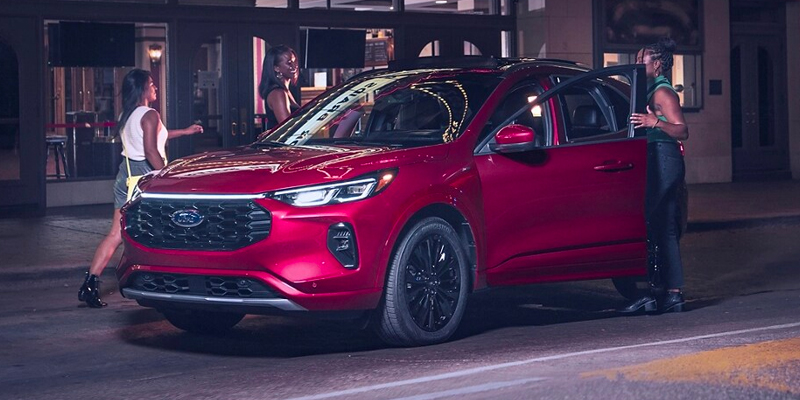
When your car enters a curve at night, traditional headlights may fail to fully illuminate the road ahead. With Ford Adaptive Headlights, you don’t have this problem; your headlights detect the curve and swivel to optimize your visibility.
How Adaptive Headlights Work
While driving at night, you only have clear visibility inside the cones of light cast ahead by your headlamps. Anything outside this lit area is in darkness, which is fine when the road is straight and easily illuminated. However, when the road curves or you corner, you’re about to enter that dark patch to the left or right, and you need to see it clearly.
This is where adaptive headlights help. Rather than being fixed in place, the headlight harness can swivel. Using a sensor in your steering wheel, the headlights swivel in the same direction to the same degree, which lights up the area of road you’re moving into. At the same time, the headlight on the outside of the curve may shorten its beam length, while the inside beam lengthens for even better illumination of the curving road.
How Adaptive Headlights Keep You Safe
With improved visibility, you’ll have less risk of a nighttime collision. You’ll see other vehicles sooner. You’re also less likely to miss a deer, cyclist, pedestrian, or parked car at the edge of the road.
This is a significant benefit, as 50 percent of fatal road accidents occur at night, largely due to reduced visibility. Adaptive headlights also reduce your stress and fatigue from eye strain.
How to Activate Ford Adaptive Headlights
To use this feature, you’ll first need to activate Autolamp mode in your Ford, which allows your headlights to automatically turn on in low-light conditions. Autolamp may already become active by default whenever you start your car.
Then, to turn on adaptive headlights, you can use your SYNC system. In Settings, go to Vehicle, and tap Lighting. You can then toggle Adaptive Headlights on or off. Note that you can only use this feature when traveling over 3 mph.
Adaptive Headlights vs Automatic High Beams
Some people mix up these two valuable features. Automatic high beams reduce the risk of blinding other drivers with the glare of your high-beam bulbs. With the feature active, your car detects oncoming cars and lowers the high beams as they pass before turning them back up again, which saves you from having to remember each time. Automatic high beams can be both fixed or adaptive.
Let us show you how adaptive headlights work in your favorite Ford model. Visit Coughlin Ford of Heath in Newark, OH, for personalized customer service from experienced Ford technicians.
Connect with us


- February 2026
- January 2026
- December 2025
- November 2025
- October 2025
- September 2025
- August 2025
- July 2025
- June 2025
- May 2025
- April 2025
- March 2025
- February 2025
- January 2025
- December 2024
- November 2024
- October 2024
- September 2024
- August 2024
- July 2024
- June 2024
- May 2024
- April 2024
- March 2024
- February 2024
- January 2024
- December 2023
- November 2023
- October 2023
- September 2023
- August 2023
- July 2023
- June 2023
- May 2023
- April 2023
- March 2023
- February 2023
- January 2023
- December 2022
- November 2022
- October 2022
- September 2022
- August 2022
- July 2022
- June 2022
- May 2022
- April 2022
- March 2022
- February 2022
Archives
- 2022 Ford Models
- 2023 Ford Models
- 2024 Ford Models
- 2025 Ford Models
- 2026 Ford Model
- Air Filter Replacement
- Battery Warning Light
- Check Engine Light
- Collision Warning
- Columbus, OH Ford Dealer
- Coughlin Ford of Heath Auto Repair
- Coughlin Ford of Heath Service
- Family Car
- Ford Accessories
- Ford Adaptive Cruise Control
- Ford Bronco
- Ford Dashboard Warning Lights
- Ford Escape
- Ford Escape Specs
- Ford Explorer
- Ford F-150
- Ford F-150 Lightning
- Ford F-250 Super Duty
- Ford Maverick
- Ford Mustang
- Ford Ranger
- Ford SUVs
- Ford Technology
- Ford Trucks
- Fuel System
- Heath Ford Dealer
- Heath Ford Service
- Heath Used Cars
- Heath, OH Community
- New Model Year Ford
- Off-Road Vehicle
- Oil Pressure Warning Light
- Restaurants in Heath, OH
- Service Tips
- Things To Do Near Columbus, OH
- Towing Capabilities
- Trims & Features
- Uncategorized
- Vehicle Financing in Ohio